
The U.S. Sentencing Commission’s amendments to the Federal Sentencing Guidelines are set to take effect on November 1, 2026.
The 2026 edition of the Guidelines includes seven principal changes: they eliminate 26 rarely-applied specific offense characteristics, raise monetary thresholds under the “loss table” to account for inflation, add fentanyl-related substances to the drug guidelines, replace the multiple-count framework, place sentencing options before the Sentencing Table, add references for two new federal offenses, and make technical corrections throughout the Guidelines Manual.
Elimination of Rarely Used Guidelines Provisions
The 2026 amendments to the Guidelines remove 26 specific offense characteristics that courts did not apply during the last five fiscal years. Some provisions dated to the original 1987 Manual. The Commission also deleted commentary that explained those provisions and renumbered the remaining subsections, application notes, and cross-references.
The deleted provisions include the five-level increase under U.S.S.G. § 2A5.1(b) for Death Resulting from Aircraft Piracy; the two-level weapon increase and fourteen-level floor under § 2B1.5(b)(6) for Weapon Use in Cultural-Heritage Offenses; the enhancement under § 2B2.3(b)(3) for Protected-Computer Loss; and the fourteen-level floor under § 2B6.1(b)(3) for Organized Vehicle-Theft Scheme. The 2026 amendments also remove additional, little-known provisions from the drug, environmental, obstruction, and regulatory Guidelines.
The 2026 amendments do not replace those provisions with general enhancements. Instead, courts applying the 2026 Guidelines may consider the underlying conduct under another applicable Guideline provision or under § 3553(a) factors. That tracks with the Commission’s 2025 amendments which eliminated Guideline Departures and directed courts to instead apply § 3553(a). Because courts rarely applied these provisions, the change should affect few cases.
Inflationary Adjustments to the Loss Table Under § 2B1.1
The 2026 Guidelines will likely affect economic-offense cases mostly because they revise the “loss amount” table under U.S.S.G. § 2B1.1. The Commission last adjusted the monetary tables in 2015 using 2014 dollars. In light of significant inflation since then, the Commission concluded that the current monetary thresholds generate harsher punishment than before based on the same monetary amounts.
Using the relationship between $1.00 in 2014 and approximately $1.36 in 2025, the Commission adjusted the thresholds for inflation and rounded them according to prescribed increments. Because the higher fine table can produce a greater fine, the 2026 Guidelines direct courts to use the fine table in the 2025 amendments for offenses committed on or after November 1, 2015, but before November 1, 2026.
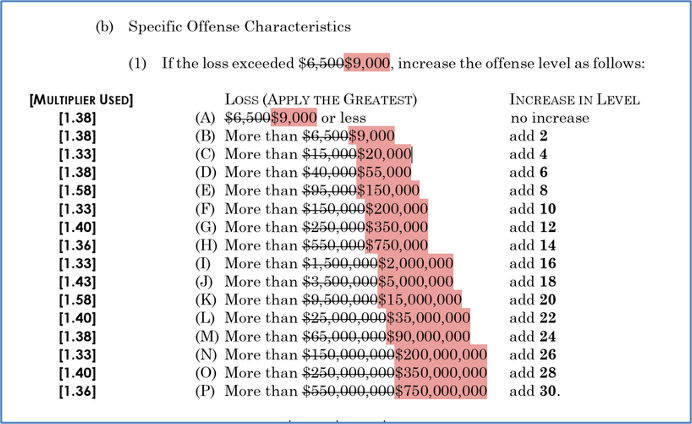
The 2026 Guidelines will make corresponding changes to the burglary, robbery, antitrust, and tax tables and to provisions that use or cross-reference the loss table. The new loss table under § 2B1.1(b)(1) now provides the following thresholds and corresponding offense level increases:
The 2026 Guidelines will raise the minimum and maximum fine amounts in § 5E1.2(c) (Fine Table for Individual Defendants) and the organizational base fines in § 8C2.4(a) (Base Fine). The Commission sought real-dollar equivalence: the incarceration consequences tied to a given nominal loss generally decrease, while nominal fine amounts generally increase.
Amendments to the Drug Guidelines
The 2026 Guidelines will implement the HALT Fentanyl Act, Pub. L. No. 119-26, 139 Stat. 410 (2025), through which Congress permanently placed fentanyl-related substances in Schedule I and applied the same mandatory-minimum sentences that govern fentanyl analogues.
The amendments add “fentanyl-related substance” to the Drug Quantity Table under § 2D1.1(c) and Application Note 8(D) (Drug Equivalency Tables). By default, those provisions now assign fentanyl-related substances the same quantity thresholds and base offense levels as fentanyl analogues.
However, the 2026 amendments also create a limited exception to that rule. If the defendant establishes that the relevant substance blocks, diminishes, or counteracts fentanyl’s effects, or that the substance has significantly less potency than fentanyl, the court should determine the base offense level through the converted drug weight of the most closely related controlled substance under § 2D1.1, Application Note 6. The parties may need expert evidence on chemical identity, pharmacological function, potency, and the appropriate comparator in applying these Guidelines.
The 2026 Guidelines will add fentanyl-related substances to the substances covered by the misrepresentation and marketing enhancement in § 2D1.1(b)(13). The provision imposes a four-level increase when a defendant knowingly misrepresents or knowingly markets the substance as another substance. It imposes a two-level increase when a defendant markets the substance as a legitimately manufactured drug and recklessly disregards that it is not. In a case involving a fentanyl-related substance, the enhancement applies only if the court uses the offense level specified in the Drug Quantity Table for fentanyl, a fentanyl analogue, or a fentanyl-related substance.
Compared with the 2025 Guidelines, the 2026 Guidelines expressly assign fentanyl-related substances to a quantity-based framework that often produces substantial offense levels. The potency-and-function exception permits a different comparator and may lower the base offense level when the evidence satisfies its terms.
Changes in Calculating the Guidelines in Cases Involving Multiple Counts
The 2026 Guidelines substantially change how courts calculate the advisory range when a defendant is sentenced on multiple counts. The amendments eliminate the former grouping rules in Chapter Three, Part D—§§ 3D1.1 through 3D1.5—and replace them with a single, revised § 3D1.1 that will govern multiple-count cases. Most importantly, the 2026 amendments eliminate the former unit calculation.
The amendments will also change the relevant conduct rules in § 1B1.3. Under the 2025 Guidelines, § 1B1.3(a)(2) applied to offenses that would have been grouped under former § 3D1.2(d). The 2026 Guidelines will use § 1B1.3(d) to specify which offense Guidelines are subject to § 1B1.3(a)(2), which are not, and which require a case-specific determination.
Under the new version of § 3D1.1, courts now must:
- identify and exclude counts that require mandatory consecutive sentences under subsection (e);
- aggregate qualifying counts that use the same listed offense guideline under subsection (a);
- calculate qualifying counts separately and apply the prescribed increase when they involve different victims or occasions under subsection (b);
- calculate the offense level separately for all remaining counts under subsection (c); and
- use the highest offense level produced under subsections (a), (b), and (c), as directed by subsection (d).
For example, when a defendant faces sentencing on two wire-fraud counts governed by § 2B1.1, subsection (a) requires the court to determine one offense level using the combined offense behavior taken as a whole. If the defendant also faces sentencing on a tax-evasion count governed by § 2T1.1, subsection (c) requires the court to calculate that count separately because it is the only count governed by that guideline. Subsection (d) then directs the court to use the higher of the offense level calculated for the combined wire-fraud counts and the offense level calculated for the tax-evasion count.
Subsection (b) applies when multiple counts governed by the same listed guideline involve different victims or the same victim on different occasions. If a defendant is convicted of two robbery counts involving the same victim on different occasions, the court calculates each count separately and adds two levels to the count producing the higher offense level. Subsection (e), by contrast, excludes counts carrying mandatory consecutive sentences. Thus, when a defendant is convicted of bank robbery under 18 U.S.C. § 2113 and a related firearm offense under 18 U.S.C. § 924(c), the court calculates the robbery offense level under § 2B3.1 without applying the otherwise applicable weapon-possession or weapon-use enhancement. The court then imposes the applicable § 924(c) term consecutively under § 5G1.2(a).
The Commission intended this new system to simplify the multiple-count calculation without materially changing the basic principles behind the prior rules. The goal remains to account for the total harm caused by multiple offenses while imposing progressively smaller increases for additional counts.
Sentencing Options
While the 2026 Guidelines leave every imprisonment range in the Sentencing Table unchanged, they add introductory commentary and new § 5A1.1 (Sentencing Table) which explains the table’s offense-level and criminal-history axes and identifies the sentencing options available in Zones A through D.
Subject to applicable statutory limitations, Zone A permits probation; probation conditioned on intermittent confinement, community confinement, or home detention; a split sentence; or imprisonment. Zone B permits probation when intermittent confinement, community confinement, or home detention satisfies the minimum term of imprisonment; a split sentence that includes at least one month of imprisonment; or imprisonment.
Zone C permits a split sentence in which imprisonment satisfies at least one-half of the minimum term, or a sentence of imprisonment. Zone D permits imprisonment only. A fine may also serve as the sole sanction when the Guidelines do not require imprisonment.
The 2026 Guidelines do not change the applicable imprisonment ranges or create new sentencing options; § 5A1.1 instead collects and presents options that previously appeared throughout Chapter Five. Statutory restrictions—including mandatory minimums, statutory maximums, and probation ineligibility—continue to control.
New Statutory References and Technical Changes
The 2026 amendments add two recently enacted offenses to Appendix A. Appendix A now references 15 U.S.C. § 9901 (Prohibition on Transfer of Personally Identifiable Sensitive Data of United States Individuals to Foreign Adversaries) to § 2H3.1 (Interception of Communications; Eavesdropping; Disclosure of Certain Private or Protected Information). It also references 18 U.S.C. § 1352 (Demands by Foreign Officials for Bribes) to § 2C1.1, the bribery guideline. These references identify the applicable Chapter Two guideline for each offense; they do not change the offense levels within those guidelines.
The 2026 amendments also make technical and stylistic corrections. The Commission describes these corrections as non-substantive. They replace “Bureau of Prisons” with “Federal Bureau of Prisons,” update statutory citations in the definition of “interactive computer service,” correct subdivision labels, and repair typographical errors.
Effective Date and Retroactivity
The Commission submitted the 2026 amendments to the Guidelines to Congress under 28 U.S.C. § 994(p) and selected November 1, 2026, as the effective date. The 2026 Guidelines will take effect on that date unless Congress intervenes.
Amendments to the Guidelines are generally not retroactive unless specified. Under 18 U.S.C. § 3582(c)(2), a defendant serving a sentence may seek a reduction only when the Commission lists the relevant change in § 1B1.10(d) and the defendant satisfies the statute and policy statement. The 2026 Guidelines do not currently list the 2026 changes for retroactive application.